(1) Concept Review
(2) Variables and Measures
(3) Variables
- Validity
October 1, 2026
Concepts: define our terms in a way that is transparent and can be used systematically. If concepts are opaque or idiosyncratic \(\to\) STOP! (board)
Variables: translate concepts into something that we can (in principle) observe. If variables do not correspond to the concept / correspond to other concepts \(\to\) STOP!
Measurement: devise transparent and systematic procedures with known uncertainty to variable in specific cases. If procedure is opaque, suffers from bias, has high uncertainty \(\to\) STOP!
“Misinformation is know it when I see it”:
“Misinformation is factually inaccurate information OR whatever is on social media”:
What is misinformation?
What is disinformation?
How can we observe misinformation in a way that lets us evaluate whether:
“Misinformation has become more widespread in recent years.”
How can we observe disinformation in a way that lets us evaluate whether:
“Disinformation has become more widespread in recent years.”
variable: A measurable property of cases that corresponds to a concept or part of a concept and can potentially take on different values across cases and time (it varies across cases).
measure: A procedure for determining the value a variable takes for specific cases through observation.
NOTE: whats the difference?
Variables can be more or less precise: “level of democracy” vs “ratio of price per area of ads vs classified ads in printed newspapers”
What is the tallest mountain on Earth?
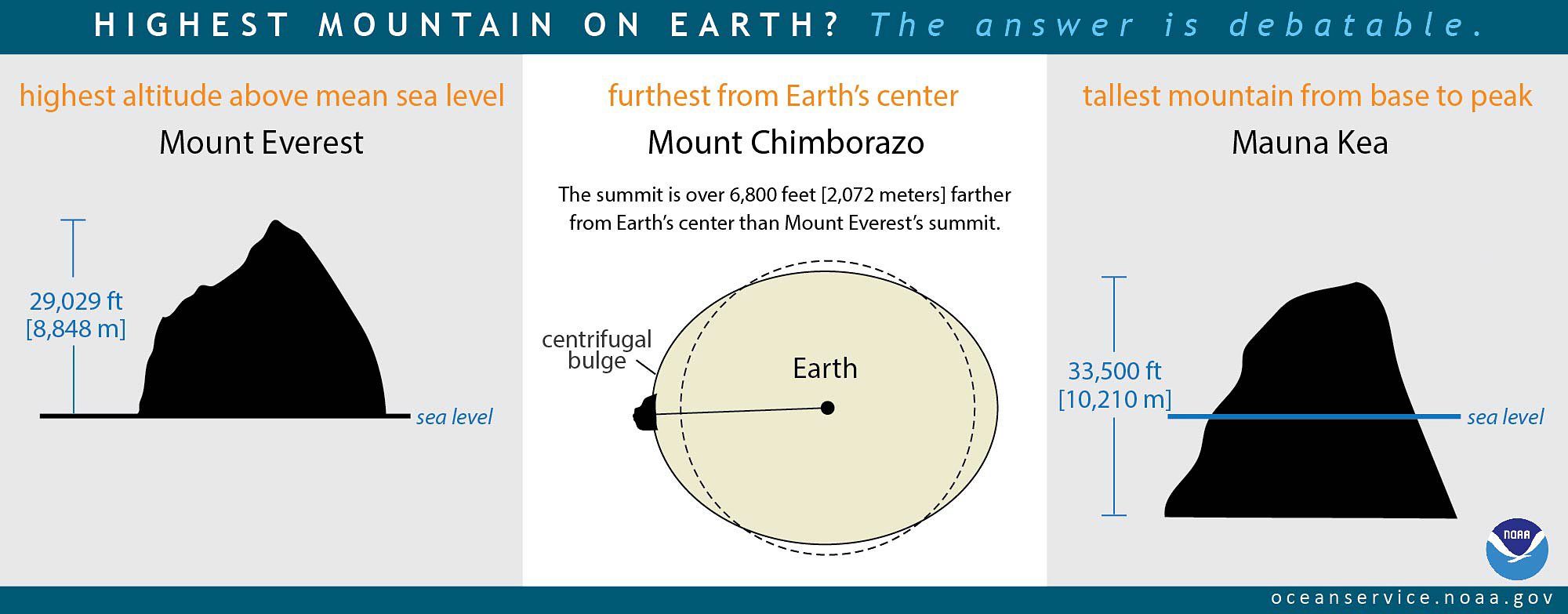
What is the tallest mountain on the North Shore?
Elevation (distance from peak to sea level)
Vertical distance in meters from mean sea level to the top of the peak
Use difference in barometric pressure at Burrard Inlet and peak to calculate difference in elevation

Are you going to climb the mountain? Prominence might be a better concept of height.
the elevation of a summit relative to the highest point to which one must descend before reascending to a higher summit
Vertical distance in meters from top of the peak to lowest contour line surrounding it and no other higher peaks.
Satellites using radar interferometry create topographical maps; computer algorithm to find lowest contour
Different concepts \(\to\) different variables
Different variables \(\to\) different measures
Different Answer:
Claim: “Canadian exposure to misinformation has increased in recent years.”
Claim: “Canadian exposure to misinformation has increased in recent years.”
Concept: exposure to misinformation
Variable: Proportion of people who believe it is hard for them to distinguish between true and false information.
Measure: Ask random sample of Canadians to answer whether they find distinguishing true vs. false information is “harder”, “easier”, or “unchanged” now compared to 3 years ago.
Claim: “Conservative Twitter/X users are exposed to more misinformation.”
Claim: “Conservative Twitter/X users are exposed to more misinformation.”
Concept: falseness of a message
Variable: rating of a statement on a scale of (True, Mostly True, Half True, Mostly False, False, Pants on Fire)
Measure: Ratings of Fact-checked statements on PolitiFact.com. Methodology Here.
Claim: “Conservative Twitter/X users are exposed to more misinformation.”
Concept: message exposure
Variable: Number of tweets posted by “elite” (e.g., politicians, bureaucrats, famous personalities, advocacy groups, and media organizations) accounts followed by the user
Measure: Twitter/X API to find follows, tweets.
Concept: exposure to misinformation
Variable: The average falseness of messages by elite (e.g., politicians, bureaucrats, famous personalities, advocacy groups, and media organizations) X users followed by a person, weighted by the number of Tweets made by each elite.
Claim: “Conservative Twitter/X users are exposed to more misinformation.”
Concept: political ideology
Variable: A score between -1 (liberal) to 1 (conservative) based on the ideology of accounts a user follows on Twitter.
Measure: Elite accounts labeled with known ideology; users scored by ideology of accounts they follow.
Different issues:
Even if we develop a concept that is transparent and systematic…
This may mean…
validity: Degree of “fit” between a variables the concept the variable is intended to capture.
In our discussion: some of the concerns were about measurement:
How do you know if the problem is with validity:
even if we are able to perfectly observe (measure) something, we think still don’t capture the concept from the claim.
“State of Bihar isn’t the most politically corrupt in India”
Concept: Political Corruption or “the use of power by government officials for illegitimate private gain”
Variable: Fraction of political officeholders in a place prosecuted for corruption
Measure: Match criminal court defendants in corruption prosecutions to list of politicians.
(board)
Claim: “The risk of being a victim of a violent crime is less in Canada than the United States”
Variable: Number of violent crimes
Where do validity problems come from?
failure to correspond to the concept
attributes other than our concept affect what we observe.
Stats Canada found that in 2025: 47% of Canadians said “it was … more difficult than it was three years earlier to distinguish between true and false information”
Can we conclude that “misinformation is getting worse”?
Claim: “Canadian exposure to misinformation has increased in recent years.”
Concept: exposure to misinformation
Variable: Proportion of people who believe it is hard for them to distinguish between true and false information.
Measure: Ask random sample of Canadians to answer whether they find distinguishing true vs. false information is “harder”, “easier”, or “unchanged” now compared to 3 years ago.
Measuring exposure to misinformation from political elites on Twitter

Concept: exposure to misinformation
Variable: The average falseness of messages by elite (e.g., politicians, bureaucrats, famous personalities, advocacy groups, and media organizations) X users followed by a person, weighted by the number of Tweets made by each elite.
Claim: “Conservative Twitter/X users are exposed to more misinformation.”
Concept: political ideology
Variable: A score between -1 (liberal) to 1 (conservative) based on the ideology of accounts a user follows on Twitter.
Measure: Elite accounts labeled with known ideology; users scored by ideology of accounts they follow.
It is not enough to just imagine that there might be a validity problem: